the court
The court is a narrow, enclosed yard that forms the physical and symbolic passage between the public by-street and the private laboratory building where Dr. Jekyll conducts his secret experiments. It is the setting for the pivotal 'Incident at the Window,' in which Utterson and Enfield witness Jekyll's sudden, horrifying transformation into Hyde, and it functions throughout the narrative as a liminal space that connects the respectable facade of Jekyll's life to the hidden, monstrous reality within.
Physical Description and Location
The court is a small, enclosed yard that lies behind the by-street, accessible through an entry that breaks the line of shops. It is described as "very cool and a little damp, and full of premature twilight, although the sky, high up overhead, was still bright with sunset." This description establishes the court as a place of perpetual gloom, cut off from the full light of day even when the sky above remains clear. The court is overlooked by three windows on the first floor of the laboratory building, one of which is the window of Dr. Jekyll's cabinet. The middle window is the one through which Jekyll is seen during the incident. The court's physical characteristics—its dampness, its premature twilight, its enclosure—create an atmosphere of confinement and secrecy, a space where the normal rules of light and visibility are suspended.
The Incident at the Window
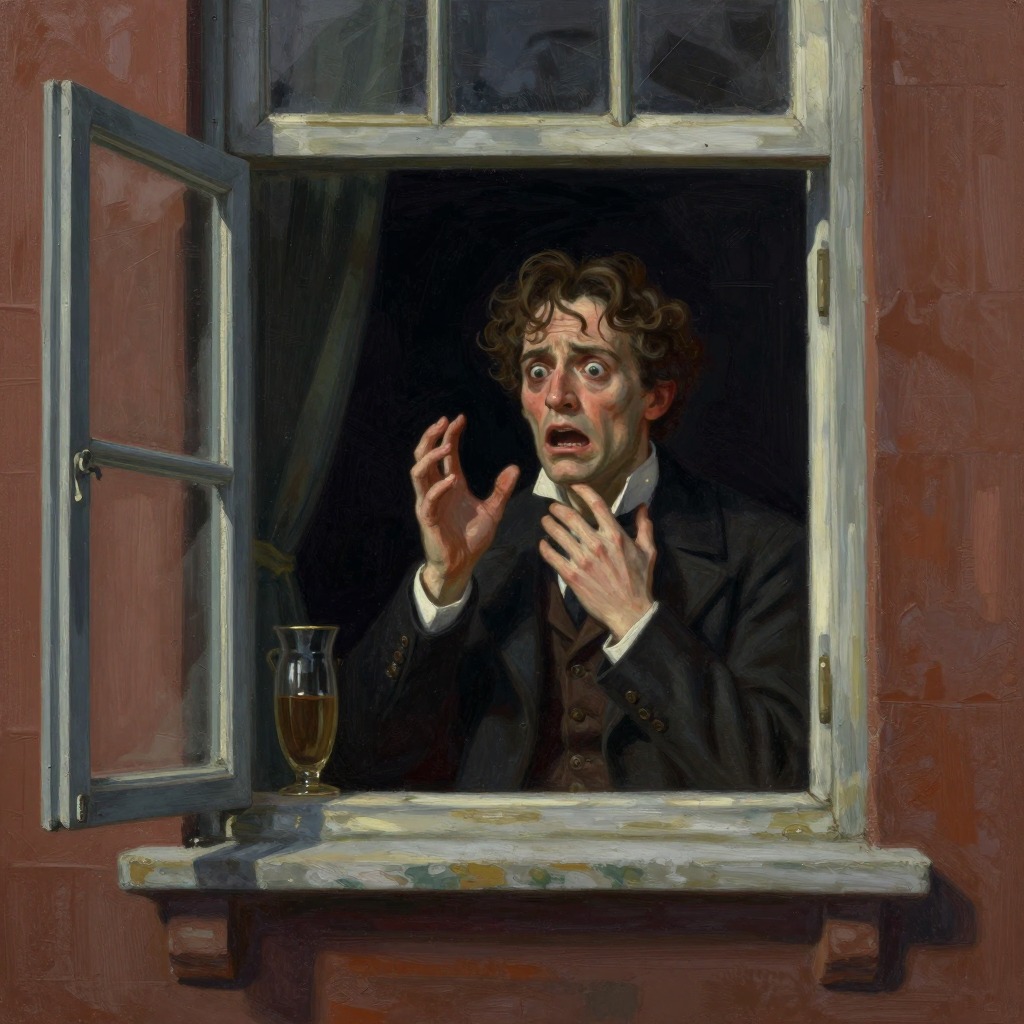
The court is the stage for the most direct and terrifying glimpse of Jekyll's condition that Utterson and Enfield receive before the final catastrophe. During their Sunday walk, Utterson suggests they step into the court to look at the windows, expressing his unease about Jekyll. There, they see Dr. Jekyll sitting close beside the middle window, "taking the air with an infinite sadness of mien, like some disconsolate prisoner." Jekyll speaks to them from the window, expressing his gladness to see them but refusing their invitation to take a walk, saying he "dare not." The conversation is cut short when Jekyll's face is suddenly "struck out" of its smile and replaced by "an expression of such abject terror and despair, as froze the very blood of the two gentlemen below." The window is instantly thrust down, and Utterson and Enfield leave the court in silence, both pale and sharing "an answering horror in their eyes." This incident transforms the court from a mere architectural feature into a site of revelation, where the hidden horror of Jekyll's dual existence breaks through the surface of ordinary life.
Narrative and Symbolic Significance
The court functions as a threshold space that mediates between the public, respectable world of the by-street and the private, secret world of the laboratory. It is the only point where the two realms visibly intersect, and it is here that the boundary between them is most dramatically breached. The court's perpetual twilight and dampness mirror the moral and psychological obscurity that surrounds Jekyll's condition. The image of Jekyll as a "disconsolate prisoner" looking out from the window reinforces the theme of confinement and entrapment that runs through the narrative. The court is also the place where Utterson and Enfield, who have previously only heard about Hyde, directly witness the terror that Hyde inspires. The silence that follows the incident—the two men leave the court without a word—underscores the court's role as a space of unspeakable knowledge, a place where the horror is seen but cannot be articulated. The court thus becomes a spatial emblem of the story's central mystery: the visible but incomprehensible connection between the respectable Dr. Jekyll and the monstrous Mr. Hyde.